Water Cycle Words in English for Kids
The water cycle moves water continuously between land, oceans, and air. In this guide to Water Cycle Words in English for Kids: Vocabulary and Activities, your child will learn the terms, build sentences, and practise through experiments and games. Begin with rain, clouds, and puddles, then introduce evaporation and condensation. Your child will describe what water does, where it goes, and how it returns.
Core Water Cycle Words and Phrases
For Water Cycle Words in English for Kids: Vocabulary and Activities, begin with words your child can see or act out. Introduce scientific terms after the sequence makes sense. A child who says “The sun heats the water” can connect that action with evaporation.
Teach action words with the nouns: heat, evaporate, rise, cool, condense, fall, flow, collect. Your child can then explain a process instead of reciting labels. Begin with short answers and expand them: “Water rises” becomes “Water evaporates and rises as water vapour.”
The Water Cycle in Simple Sentences
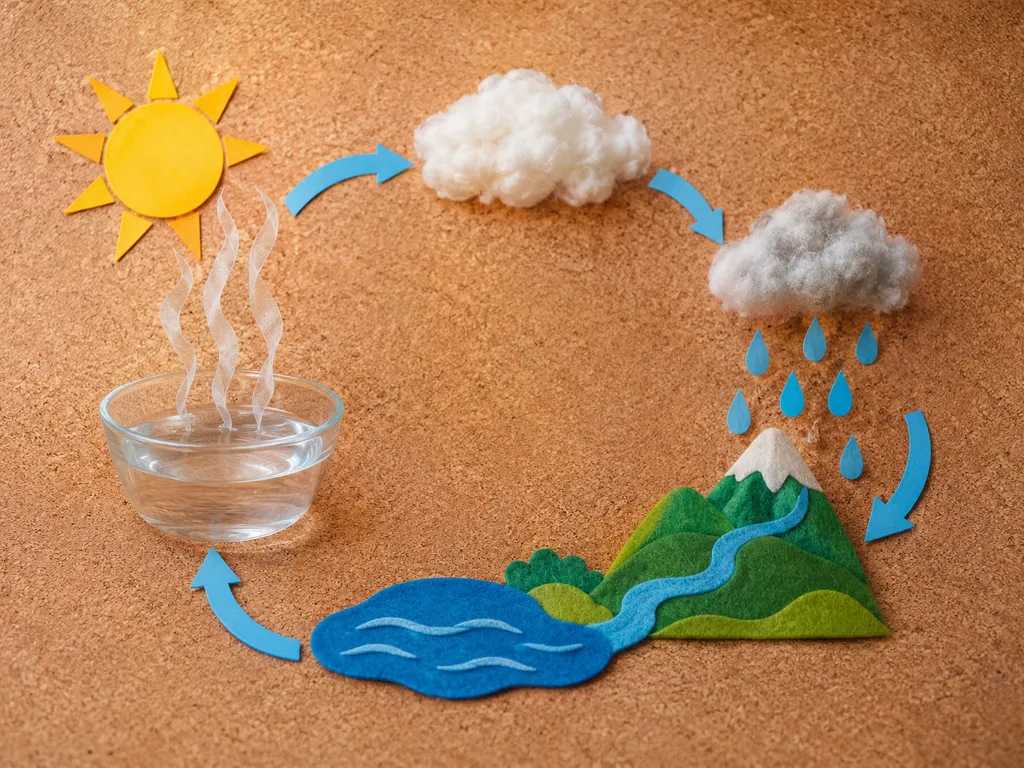
When practising Water Cycle Words in English for Kids: Vocabulary and Activities, build one connected explanation. The sun heats water in seas, lakes, rivers, and wet ground. Liquid water evaporates into water vapour, rises with warm air, and cools.
Cooling water vapour condenses into tiny droplets that can form clouds. Water or ice falling from a cloud is precipitation. Depending on conditions, precipitation falls as rain, snow, or hail.
Water collects in different places. Runoff flows downhill into streams, rivers, lakes, or seas. Through infiltration, water enters the soil and becomes groundwater. Ask your child to connect the cycle with “first,” “next,” “then,” “after that,” and “finally.”
Activities for Different Ages
To adapt Water Cycle Words in English for Kids: Vocabulary and Activities, change the task, not the science. Younger children need movement, pictures, and short phrases. Older children can classify terms, explain causes, and choose precise language.
If your child uses two or more languages, connect the concept across those languages before introducing the English term. Keep the final explanation in English, but allow a brief comparison with another language.
Practice at Home and in Lessons
Use real water. After rain, find puddles, window drops, wet soil, and water flowing along a path. Ask, “Where did this water come from?” and “Where might it go next?” Indoors, observe condensation on a cool glass or a damp cloth drying.
Build a Water Cycle Story
Write these words on cards: sun, water, evaporation, vapour, condensation, cloud, precipitation, collection. Arrange the mixed cards and tell the story aloud. For a challenge, add runoff, infiltration, and groundwater. Ask your child to explain each choice.
Brief, repeated practice works better than one long vocabulary test. Alternate drawings, card sorting, and spoken explanations. Across LearnLink lessons, our tutors can adapt questions and sentence support to each child’s age and English level.
Common Mix-ups to Correct
Children may understand the cycle yet confuse related terms. Correct meaning before pronunciation or spelling. Direct contrasts show what changes, where water moves, and which word describes the event.
Separate each object from its process: a cloud is not condensation, and rain is one type of precipitation. Clouds are not made of water vapour; they are visible collections of tiny liquid droplets, ice crystals, or both.
- Compare evaporation and condensation using two labeled arrows in a simple notebook diagram.
- Match four water cycle words to pictures from one familiar science book.
- Sort six example cards into evaporation, condensation, precipitation, and collection groups.
- Ask your child to explain each choice using one complete English sentence.
- Correct one mix-up by redrawing the cycle and naming every transition aloud.
When a word has several meanings or pronunciations, Cambridge Dictionary is a useful check before turning it into child-friendly examples.
Frequently Asked Questions
Which Water Cycle Words Should My Child Learn First?
Start with sun, water, cloud, rain, heat, rise, fall, and collect. These words describe the basic movement. Next, add evaporation, water vapour, condensation, precipitation, and collection. Introduce runoff, infiltration, and groundwater after your child can explain the main sequence.
How Can I Explain Evaporation and Condensation Simply?
Evaporation changes liquid water into water vapour that enters the air. Condensation reverses the process: cooling water vapour becomes liquid droplets. Compare a drying puddle with droplets on a cool glass, then ask what changed.
Should My Child Learn “Vapor” or “Vapour”?
Both spellings are correct. Vapor is standard in American English; vapour appears in British English and other varieties. Follow your child’s school or learning materials while teaching recognition of both forms. Water Cycle Words in English for Kids: Vocabulary and Activities should teach precise meaning without treating one spelling as the only valid form.
How Often Should We Practise Water Cycle Vocabulary?
Practise briefly several times during a week, then revisit the words. Vary recall: label a picture, order cards, explain a puddle, or complete a sentence. Once the task feels easy, request longer explanations using sequence words and causes before adding new terms.
Start your child's English journey today — book a trial lesson with LearnLink.
Stay updated on our latest tips and resources by following us on Instagram LearnLink.